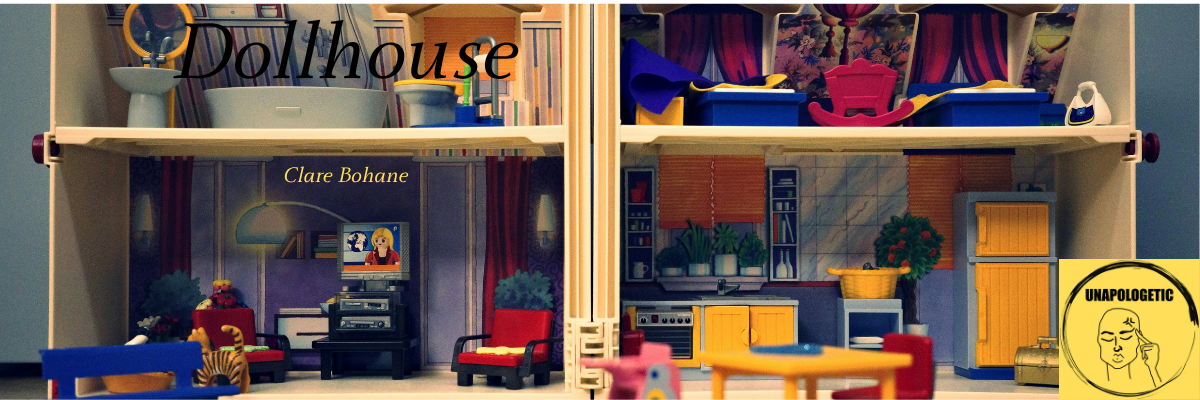
Image of a dollhouse with piece title and author name plus Unapologetic logo which has a drawing of a frustrated woman holding her finger to her temple
By Clare Bohane
It wasn’t the prettiest of dollhouses and she knew that it was broken, second-hand. The
dollhouses she had seen in the glossy Smyth’s catalogue looked different; but it was there,
and it was hers. Not fully hers, of course—she had to share it with the others—but it was
understood that she always got first go.
It was tall and didn’t have a cover, no front door or windows to peek into. It was made of
cheap plywood material and didn’t have a lot of furniture. Instead, each room had
stickered murals of appliances and household things — a wallpaper of aspirational living.
The top floor had a bedroom, and the suggested sticker tableau was a neon cubby stashed
with shoes in purple, heaped school folders and plush teddy bears. The floor was a zig zag
peach carpet. There was an ensuite bathroom with a wallpaper of bubble-gum pink fluffy
towels. Downstairs, the living room had multiple lights and neon signs. There didn’t seem
to be a functional kitchen; perhaps, the dollhouse family ate takeaways only. Ana had
discovered takeaways recently; she and Mama had them sometimes in their room in the
hotel.
There was another smaller dollhouse stored by the plastic Lego box but Ana didn’t
like that one. She didn’t like it despite the fact it had plastic flower boxes on every window
ledge with shutters and doors you could open; windows you could peer into. She
preferred the gaudy, doorless pastel house. You could see round corners in that one—you
could tell what was coming.
Every morning, when she arrived at school, Ana took up her position at this chosen
dollhouse, ordering and reordering the dolls in it. They were an odd collection: a nude,
blonde- haired sister of Barbie, a headless Cupcake doll with her yellow skirt fanned out,
an actual Barbie in a polka dot dress with one shoe missing, various Lego and Duplo men;
some with hair, some without. Ana liked lining them up together, making a family of
them.
When the others tried to play, Ana growled. She had bitten only once—a tidy little chunk
out of that red-haired girl’s freckly arm. It was enough to send a signal to the others. But
Ana wondered sometimes whether it had been worth it; having Mama dragged into
school for meetings, seeing her white-faced and hollow-eyed afterwards. Mama hadn’t
been too cross—just sad.
Ana had never bitten before, Mama had explained to the teacher through a translation
app on her phone. It must be the trauma.
Trauma. It was a word that Ana heard a lot of these days. She didn’t know what it
meant. Perhaps it was another word for anger; the anger at having to leave her pretty
things in the dead of night, at not getting to say goodbye to Sasha, at having to leave her
cat, Lyubov, with Papa. Papa. Having to leave Papa. She had a much nicer dollhouse at
home; one that Papa had built her. She wished she could tell the others that. But she didn’t
have the words yet. So she bit and she growled and she ordered and reordered her dolls.
“Clare Bohane is a writer from Cork city. She was the winner of Cork County Library’s Age Friendly Short Story Competition 2025. Her stories have appeared in Púca Literary Journal, Sparks Literary Magazine, Focal Archive and Quilted Literary Magazine. Her non-fiction writing has appeared in the Irish Examiner and the Hollybough. Miniplays Review published a short play by Clare in their December 2025 issue.”